
Defining a Data Strategy in 2026
Most organizations don't fail because they lack data — they fail because they never define how data should drive behavior and decisions across the org.
 Mory Kaba9 min read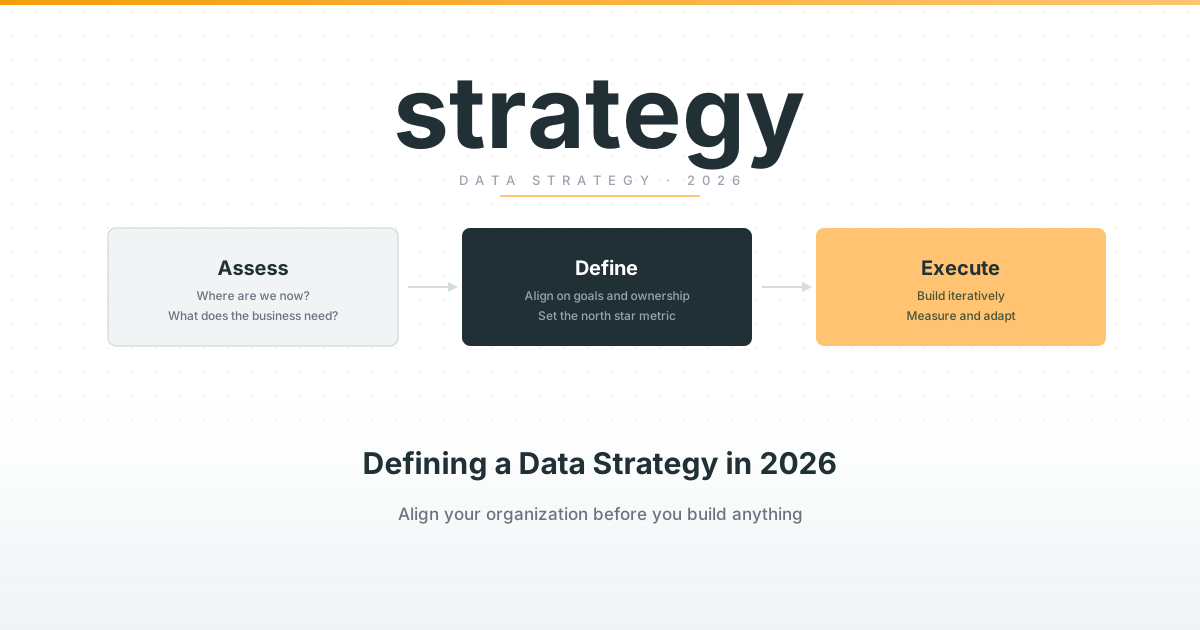
Does your company or team actually have a data strategy?
Is the organization aligned on how data should be viewed internally? Is your strategy limited to providing dashboards and running pipelines in order to “inform” the business? Is leadership actually aware of how data creates value inside the organization?
Many organizations I see have never actively reflected on how data should be treated across the business. It is usually viewed as an asset that can be used to generate “insights” into operations.
The most common strategy I encounter consists of a siloed data team responsible for “providing data to the business”. An insight generation function made up of data engineers, analysts and sometimes data scientists.
Interestingly enough, most of the time neither engineering leadership nor business leadership is actually aware of what this team is doing beyond providing analytical data and dashboards.
A common pattern looks something like this:
- Marketing wants attribution reporting
- Sales wants CRM dashboards
- Finance wants revenue and margin reporting
- Operations wants forecasting
- Product wants usage analytics
The data team reacts by building pipelines, dashboards and integrations for every request.
After a few years the organization ends up with:
- dozens of disconnected dashboards
- duplicated metrics and KPIs
- unclear ownership definitions
- rising infrastructure costs
- increasing delivery complexity
- slow development cycles
- low trust in data
- leadership still struggling to make decisions confidently
⚠️ Warning
The organization mistakes data activity for data strategy.
One of the biggest tell signs that a company never developed a proper data strategy is a disconnect between data teams, leadership and operational business units.
Key Takeaways
- A data strategy is a decision-making framework, not a technology or tooling roadmap
- Dashboards and pipelines only create value when they change operational behavior or decisions
- Lakehouses, streaming architectures, and AI initiatives are implementation choices, not strategies
- Every important metric needs a clear owner, definition, and measurable business purpose
- Data’s most underrated function is organizational alignment: a shared definition of reality across teams
What is the purpose of a data strategy?
Why are strategies so important in business?
Before answering that question, it is worth defining what a strategy actually is.
To keep things simple, I would define a strategy as the alignment on direction, purpose and objectives of an initiative.
More importantly though, a strategy is fundamentally a decision making framework.
It defines:
- what matters
- what does not matter
- what outcomes are important
- how success is measured
- how decisions should be made
If you look at other parts of the business, for example sales and marketing, a simple go-to-market strategy could look something like this:
- Target mid-sized B2B SaaS companies in Europe
- Position around operational efficiency and automation
- Focus outbound sales on founders and operations leadership
- Use content marketing to generate inbound demand
- Measure success through qualified pipeline generation and revenue growth
Pretty straightforward.
The reason strategies are so important is because they reduce uncertainty inside organizations.
People get a clear understanding of:
- what is expected from them
- what they should prioritize
- how success is measured
- what direction the company is moving towards
Humans generally struggle with uncertainty and ambiguity. Clarity and direction counterbalance this.
A proper strategy also establishes expectations.
Without clearly defined expectations and measurable outcomes, it becomes impossible to determine whether the things we are doing are actually creating the desired impact.
Sticking to the GTM example, if we never define what success actually looks like, we cannot evaluate whether the strategy is effective.
The same applies to data.
Why is defining a data strategy so difficult?
From a strategic standpoint, data is often treated as an afterthought and I believe the reason is largely related to the abstract nature of data itself.
When it comes to a sales strategy or GTM strategy, the “why” is obvious.
You need to acquire customers and generate revenue in order for the company to survive. The relationship between the function and business value is direct and visible.
With data, things become much fuzzier.
At the end of the day, data is simply information about things that happened at a certain point in time.
Data is generated to reflect events and activities happening across the organization.
- Someone ordered from your online store.
- A customer converted from trial to paid.
- A shipment arrived late.
- A machine failed.
- A support ticket was created.
These data points can then be used to understand what is happening inside the business. Classic BI and analytics use cases.
The problem is that information by itself does not create value.
No matter how structured the data is, how modern the platform is or how impressive the dashboards look, if the information does not influence behavior or decision making, it is ultimately useless.
This is one of the biggest flaws in how organizations think about data.
⚠️ Warning
Most companies overvalue information and undervalue behavioral change.
A dashboard does not create value because it exists.
Value is only created once the information changes operational behavior.
For example:
- reducing operational costs
- improving conversion rates
- accelerating delivery cycles
- increasing customer retention
- reducing system failures
- improving forecasting accuracy
- identifying operational bottlenecks faster
If no decision changes after generating an “insight”, then the insight had no business value.
This is also why many organizations struggle to justify investments into data initiatives.
The data team continuously produces dashboards, pipelines and reports, but leadership never sees a direct relationship to operational or financial outcomes.
Why many data teams become disconnected from the business
Another common problem is that data teams often operate independently from operational workflows.
The organization treats data as a separate support function instead of embedding it directly into execution and decision making processes.
This creates several problems:
- data teams optimize for technical output instead of business outcomes
- business teams view data work as slow and disconnected
- leadership struggles to understand ROI
- ownership becomes unclear
- adoption remains low
Data teams then end up measuring success through:
- number of dashboards
- number of pipelines
- platform migrations
- tooling adoption
- infrastructure maturity
But none of these are actual business outcomes.
Technology is not a strategy.
🚨 Danger
Having a lakehouse is not a strategy.
Using streaming pipelines is not a strategy.
Running AI initiatives is not a strategy.
Migrating to a modern data stack is not a strategy.
These are implementation decisions.
Technology only matters once the organization is clear on:
- what operational problems should be solved
- what business outcomes should improve
- what decisions should become easier or faster
- what measurable impact should be created
What makes a good data strategy?
1. Focus on measurable outcomes instead of tools
Many organizations define data maturity through tooling.
The conversation revolves around:
- lakehouses
- streaming architectures
- orchestration platforms
- AI initiatives
- modern data stacks
But tools are not strategies.
A good data strategy starts with operational and business problems.
For example:
- Reduce customer churn by 10%
- Reduce reporting time from 3 days to 2 hours
- Improve forecast accuracy
- Reduce operational incidents
- Improve supply chain visibility
- Reduce manual work inside operations teams
Only after defining these outcomes should the organization decide which technologies are required.
The technology exists to support the strategy, not the other way around.
2. Embed the needs of the entire organization
Data strategies often fail because they are created in isolation.
A proper data strategy cannot only reflect the needs of the data team. It needs to reflect the operational realities of the business itself.
Sales, finance, operations, product and leadership all interact with information differently.
A good strategy aligns these perspectives and creates shared visibility across the organization.
One of the most underrated functions of data is organizational synchronization.
Different departments often operate based on different assumptions about reality.
Data creates a communication anchor.
Shared definitions, shared metrics and shared visibility reduce ambiguity and internal friction.
In that sense, data is not just about reporting.
It is about organizational alignment.
3. Define ownership clearly
One of the biggest operational failures in data organizations is unclear ownership.
Data teams should not own business meaning.
They should enable access, quality, governance and infrastructure.
But operational teams need to own the definitions and outcomes tied to their business processes.
If nobody owns a KPI, it eventually becomes political.
Questions like:
- “What counts as an active customer?”
- “How do we define churn?”
- “Which revenue number is correct?”
- “Who owns forecast accuracy?”
suddenly become sources of organizational conflict.
Every important metric should have:
- a clear definition
- a clear owner
- a clear business purpose
- a measurable impact
Without ownership, scaling data across an organization becomes extremely difficult.
4. Think beyond internal reporting
Another major limitation in many data strategies is that data is only viewed as an internal reporting mechanism.
In reality, data can also become a monetizable business capability.
For example:
- customer intelligence products
- recommendation systems
- operational benchmarking
- predictive services
- partner APIs
- forecasting products
- automation systems
Many companies sit on valuable operational data but never think about how it could directly contribute to revenue generation or product differentiation.
The organizations that treat data strategically often move beyond internal analytics and start embedding data directly into products, services and operational workflows.
Final thoughts
Most organizations do not fail because they lack data.
They fail because they never define how data should influence behavior, decision making and execution across the organization.
Strategy first, platform second: what the underlying work looks like - architecture, pipelines, warehouse - follows from the decisions you want to improve, not the other way around.
ℹ️ Info
A modern data strategy is not a dashboard strategy.
It is not a tooling strategy.
And it is not an AI strategy.
It is an organizational alignment strategy centered around better decisions and measurable business outcomes.
Frequently Asked Questions
What is a data strategy?
A data strategy is a decision-making framework that defines what data outcomes matter, how success is measured, and how data should influence behavior and decisions across the organization. It is not a technology roadmap or a list of tools to adopt.
How is a data strategy different from a data architecture?
A data strategy defines outcomes and organizational direction: what problems to solve and how to measure success. A data architecture defines the technical systems used to implement those outcomes. Architecture decisions should follow from strategy, not the other way around.
Who should own the data strategy in an organization?
Data strategy ownership needs to be shared between data leadership (who owns infrastructure and delivery capability) and business leadership (who owns outcomes and definitions). A strategy owned only by the data team will reflect technical priorities, not business ones.
What is the most common failure mode in data strategy?
Treating tooling adoption as strategy. Organizations that focus on migrating to a modern data stack, building a lakehouse, or launching AI initiatives without first defining what operational outcomes need to improve end up with impressive infrastructure and no clear return on it.
How do you measure whether a data strategy is working?
Measure changes in operational outcomes, not data outputs. If churn rates improved, forecast accuracy increased, or manual operational work decreased as a direct result of data-driven decisions, the strategy is working. Measuring dashboards built or pipelines deployed does not capture business impact.
What does clear metric ownership look like in practice?
Each important KPI should have a single named owner in a business unit (not the data team), a documented definition agreed upon across teams, and a measurable business outcome it connects to. Without ownership, metric definitions drift and become sources of organizational conflict rather than decision support.
Newsletter
Get practical data engineering notes in your inbox
Occasional emails on lakehouses, dbt, Spark, RAG, and what actually works in production. No fluff, unsubscribe anytime.